Business line of credit vs. business credit card: Key differences explained

- What is a business line of credit?
- What is a business credit card?
- Key differences between a business line of credit and a credit card
- Pros and cons of a business line of credit
- Pros and cons of a business credit card
- When to use a business line of credit vs. a business credit card
- Business line of credit vs. business credit card for startups
- How to choose between a line of credit and credit card for your business
- The Ramp advantage: A smarter way to pay and control spend
A business line of credit and a business credit card both give you revolving access to capital, but they solve different financing problems. Lines of credit are typically better for larger, cash-based expenses and ongoing funding needs, while business credit cards work best for everyday spending and rewards.
The right choice depends on how much you need to borrow, how quickly you need funds, and whether you plan to carry a balance. Here’s how the two options compare and when each makes sense for your business.
What is a business line of credit?
A business line of credit is a revolving financing tool that lets you draw cash up to a set limit and repay it over time. You only pay interest on the amount you draw, and as you repay it, your available credit replenishes.
Unlike a credit card, a line of credit typically deposits funds directly into your business bank account. It functions similarly to a credit limit, but instead of swiping a card, you request funds as a transfer. That makes it useful for expenses that require cash or ACH transfers, such as payroll, rent, or vendor payments.
You can use a business line of credit to cover seasonal cash flow gaps, finance large inventory purchases, or manage unexpected expenses. When you need funds, you draw only what you need, whether that’s $1,000 or $50,000.
Key features include:
- Revolving credit: Borrow, repay, and borrow again up to your limit
- Interest charges: Pay interest only on the amount you draw
- Flexible access: Funds are transferred directly to your bank account
Secured vs. unsecured business line of credit
Business lines of credit can be secured or unsecured, and the difference affects your rates and approval odds.
A secured line of credit requires collateral, such as inventory, receivables, or other business assets. Because the lender takes on less risk, secured options often come with lower interest rates and higher limits.
An unsecured line of credit doesn’t require specific collateral, but approval typically depends on strong revenue and credit history. Many lenders still require a personal guarantee or a blanket lien on business assets, even for unsecured products.
Your choice depends on your company’s financial profile, available assets, and tolerance for personal liability.
What is a business credit card?
A business credit card is a revolving line of credit you access through a physical or virtual card to make purchases. It’s built for day-to-day operating expenses like software subscriptions, travel, vendor payments, and supplies. Like a line of credit, it can be secured or unsecured.
At the end of each billing cycle, typically monthly, you receive a statement showing your transactions, total balance, minimum payment, and due date. If you pay the full balance within the grace period, usually 21–25 days, you won’t owe interest. If you carry a balance, interest accrues on the unpaid portion.
Credit card APRs are generally higher than those of many lines of credit, but cards offer features lines of credit don’t. Some providers offer introductory 0% APR periods, which can function as short-term financing if you repay the balance before the promotional period ends. For example, some issuers offer introductory 0% APR business credit cards to help manage near-term cash flow.
Key features include:
- Revolving credit: Spend up to your limit and reuse credit as you repay
- Grace period: Avoid interest by paying in full each billing cycle
- Rewards programs: Earn cashback, points, or travel perks on eligible purchases
Other notable characteristics of business credit cards:
- Physical and virtual cards: Issue cards to employees with customizable spending limits and controls
- Built-in expense management: Many cards include tools for expense tracking and reporting
- Separation of business and personal spending: Dedicated accounts simplify bookkeeping and tax preparation
- Rewards optimization: Some programs are structured specifically around common categories of business spend
Business credit cards work best when you want immediate purchasing power, built-in controls, and the ability to earn rewards on recurring operating expenses.
Key differences between a business line of credit and a credit card
A business line of credit and a business credit card are both revolving financing tools, but they differ in limits, costs, access methods, and ideal use cases. If you need larger amounts of cash flexibility, a line of credit usually fits better. If you’re managing everyday expenses and want rewards, a credit card often makes more sense.
Here’s a side-by-side comparison:
| Factor | Business line of credit | Business credit card |
|---|---|---|
| Primary purpose | Cash flow gaps, large or seasonal expenses | Everyday operational spending |
| Credit limits | Typically higher; often six figures for established businesses | Generally lower; varies based on revenue and credit profile |
| Interest structure | Interest accrues immediately on drawn funds | Grace period; avoid interest if paid in full monthly |
| Rewards | Rarely offered | Common (cashback, points, travel perks) |
| Repayment schedule | May be daily, weekly, or monthly | Monthly billing cycle |
| Access to funds | Bank transfer to business account | Card swipe or digital payment |
| Fees | May include draw, origination, or maintenance fees | May include annual, foreign transaction, or cash advance fees |
| Collateral | May require collateral or personal guarantee | Typically unsecured but often requires personal guarantee |
| Credit reporting | Often reported to business credit bureaus | May impact business and/or personal credit depending on issuer |
| Built-in controls | Limited spend controls | Often includes expense tracking and employee card controls |
Credit limits and borrowing amounts
Lines of credit typically provide higher borrowing limits than business credit cards, making them better suited for inventory purchases, equipment, or large vendor payments. Credit cards are usually designed for smaller, recurring operating expenses.
Approval and limit size depend on revenue, time in business, and credit history. Strong financials can increase limits for either product.
Interest rates and fees
Lines of credit often carry lower interest rates than credit cards, especially for well-qualified borrowers. However, they may include draw fees, maintenance fees, or origination costs that increase total borrowing expenses.
Credit cards generally have higher APRs, but you can avoid interest entirely by paying your statement balance in full each cycle. Rewards programs can also offset some spending costs, depending on how you use the card.
For example, if you borrow $40,000 to purchase inventory and repay it over six months, even a few percentage points difference in interest can materially affect your total cost. A lower-rate line of credit may save thousands compared to carrying the same balance on a high-APR credit card.
On the other hand, if you charge $8,000 in monthly operating expenses and pay the full balance within the grace period, a business credit card effectively provides short-term, interest-free financing—plus rewards on that spending.
How you access and use funds
A line of credit deposits funds directly into your bank account. That flexibility makes it useful for payroll, rent, contractors, or vendors who don’t accept cards. A credit card provides immediate purchasing power at the point of sale. The trade-off is vendor acceptance, since some suppliers don’t accept card payments.
Rewards and perks
Business credit cards typically offer cashback, travel rewards, or points on spending. Some providers also include partner discounts and built-in spend controls. Lines of credit rarely include rewards. Their value lies in borrowing flexibility and potentially lower carrying costs.
Repayment terms and grace periods
Credit cards include a grace period that allows interest-free repayment if you pay your balance in full each billing cycle. That can make them a powerful short-term financing tool. With a line of credit, interest starts accruing when you draw funds. Repayment schedules vary by lender and may include interest-only options during the draw period.
Pros and cons of a business line of credit
A business line of credit is best when you need flexible access to larger amounts of capital, but it comes with qualification hurdles and potential fees. Here’s what to consider.
Pros of a business line of credit
- Higher credit limits: Better suited for large purchases or significant cash flow gaps
- Lower borrowing costs: Often more affordable than credit cards when carrying a balance
- Flexible use of funds: Pay vendors, payroll, rent, or other expenses that don’t accept cards
- Draw as needed: Borrow only what you need instead of taking a lump sum
- Reusable capital: As you repay, your available credit replenishes
Cons of a business line of credit
- Stricter approval requirements: Lenders often require strong revenue, operating history, and documentation
- Additional fees: May include origination, draw, or maintenance fees
- No rewards programs: You won’t earn cashback or points on spending
- Potential collateral or guarantees: May require assets or a personal guarantee
- Interest accrues immediately: No grace period like a credit card
Pros and cons of a business credit card
A business credit card gives you fast access to purchasing power and built-in controls, but it can become expensive if you carry a balance. Here’s how the trade-offs break down.
Pros of a business credit card
- Easier approval: Typically requires less documentation and shorter operating history than a line of credit
- Rewards programs: Earn cashback, points, or travel perks on everyday spending
- Interest-free grace period: Avoid interest entirely by paying in full each billing cycle
- Immediate access to funds: Make purchases instantly without waiting for transfers
- Employee card controls: Set spending limits and monitor usage in real time
- Credit building: Responsible use can help establish and strengthen your business credit profile
Cons of a business credit card
- Higher interest rates: Carrying a balance can become costly quickly
- Lower credit limits: May not cover large equipment purchases or major inventory orders
- Vendor acceptance limits: Some contractors or landlords don’t accept card payments
- Personal guarantee requirements: Many issuers require personal liability, which can impact your personal credit
- Overspending risk: Easy access to credit can lead to accumulated debt without strong controls
When to use a business line of credit vs. a business credit card
The right option depends on the size and timing of your expenses, your need for rewards, and whether you plan to carry a balance. Many businesses use both strategically.
Best uses for a business line of credit
- Covering seasonal cash flow gaps or revenue slowdowns
- Financing large inventory purchases or equipment
- Paying vendors or contractors who don’t accept card payments
- Managing unexpected large expenses or emergency repairs
- Funding projects that require flexible, cash-based payments
Best uses for a business credit card
- Managing everyday business expenses such as supplies and subscriptions
- Covering routine operating expenses
- Booking travel and earning cashback or points
- Issuing employee cards with built-in spending controls
- Taking advantage of introductory APR offers for short-term financing
Used together, a credit card can handle day-to-day spend and rewards optimization, while a line of credit provides backup liquidity for larger or less predictable needs.
Business line of credit vs. business credit card for startups
For most startups, a business credit card is easier to qualify for than a line of credit. Lenders typically require established revenue and operating history for lines of credit, which many early-stage companies don’t yet have.
Business credit cards often rely more heavily on the founder’s personal credit score than on business financials. That makes them a practical starting point while you work on building your business credit and strengthening your company’s financial profile.
A practical approach for startups:
- Start with a business credit card: Easier approval and immediate access to working capital
- Use it responsibly: Pay on time and keep utilization low to build credit history
- Add a line of credit later: Once you have consistent revenue and stronger financials
As your business matures, adding a line of credit can give you higher limits and more flexible cash access. Until then, a well-managed credit card often covers day-to-day needs.
How to choose between a line of credit and credit card for your business
Choosing between a business line of credit and a business credit card comes down to how you plan to use the funds and how comfortable you are carrying a balance. Ask yourself these questions when comparing business credit cards:
- How large are the expenses? Large or irregular purchases often favor a line of credit. Routine operational spending favors a credit card.
- Will you carry a balance? If yes, a line of credit may offer lower long-term borrowing costs. If no, a credit card’s grace period can provide interest-free financing.
- Do you want rewards? If earning cashback or travel points matters, a credit card is the better fit.
- Do your vendors accept cards? If not, a line of credit gives you more flexibility.
- What’s your qualification profile? Newer businesses may qualify for credit cards more easily than lines of credit.
In many cases, the most effective strategy is to use both: a credit card for everyday expenses and rewards, and a line of credit as a liquidity backstop for larger or unexpected needs.
The Ramp advantage: A smarter way to pay and control spend
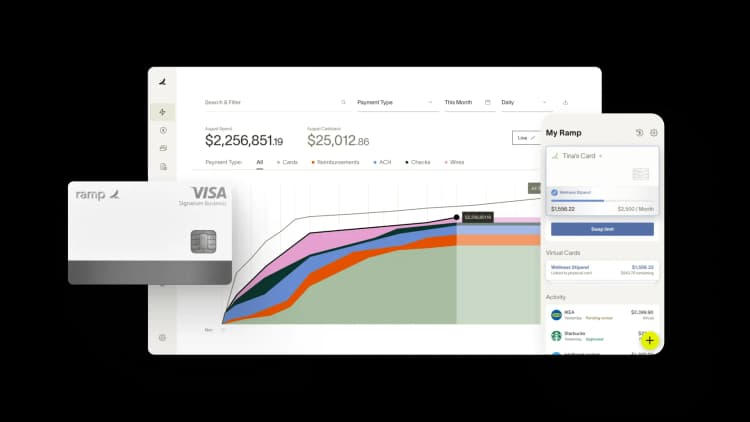
If you’re leaning toward a business credit card but want stronger controls and automation, Ramp offers a modern corporate card built for finance teams. It combines flexible spending with integrated spend management tools and accounting automation.
Ramp has no annual fees, and credit limits are based on company financials rather than a single personal credit score. You can issue employee cards with built-in controls, automate receipt matching, categorize expenses in real time, and sync directly with your accounting system.
Beyond traditional card features, Ramp provides real-time visibility into company spend and access to partner rewards. On average, Ramp customers report saving 5% across total spend through better controls and pricing intelligence. Learn more about how Ramp helps businesses save 5%.
If you want to see how it works, request a demo.

FAQs
Yes. A credit card is a type of revolving line of credit. The key difference is how you access funds and how interest works: credit cards use a grace period, while traditional business lines of credit typically begin accruing interest as soon as you draw funds.
Yes, an LLC can apply for a business line of credit. Lenders usually evaluate business revenue, time in operation, cash flow, and the owner’s personal credit history before approving the application.
It often does. Many lenders perform a hard credit inquiry during the application process and may require a personal guarantee. Both can temporarily affect your personal credit score.
Yes. Many businesses use both strategically. A credit card can handle everyday expenses and rewards, while a line of credit provides larger borrowing capacity and liquidity for cash flow gaps.
A business line of credit is revolving, meaning you can draw and repay funds repeatedly up to your limit. A business loan provides a lump sum upfront with fixed repayment terms and a defined payoff schedule. Lines of credit offer ongoing flexibility, while loans are better for one-time, predictable expenses.


“A well-run district should not have to choose between getting work done at the school site and keeping control of the dollars behind it. We're not hiring more people to do more jobs, so we have to be smarter about the process. With Ramp, the purchase, the receipt, and the record stay together from the start. ”
Nick Brizeno
Director of Purchasing, San Marcos Unified School District

“Invoices, cards, tokens. The categories change but the principle doesn't: know where the money is going, remove the work around it, and make sure the spend is worth it.”
Maciej Mylik. Finance
ElevenLabs

“There's just no surprises anymore. No more waiting two months to find out how a job did. We know how it's doing as it's happening.”
Erich Kuss
Financial Systems Manager, Infinity Home Services

“More token spend isn’t proof that AI is working. Less isn’t proof that it isn’t. What matters is whether we’re buying the right level of intelligence for the work. Ramp lets us make that judgment in the same place we manage every other type of spend.”
Cody Nutt
Senior Director of Business Systems, Daxko

“Most banks treat the back office as a cost to keep down. We treat ours as a return to compound, which is why we run it on Ramp. Now we put our clients on Ramp, too.”
Patrick Gaughen
President & COO, Hingham Institution for Savings

“Browserbase builds infrastructure so AI agents can do real work. Ramp is doing the same for finance. It’s not another tool. It’s a system purpose-built for AI-driven finance, and that’s why we chose Ramp as our financial operating system from day one.”
Paul Klein IV
Founder & CEO, Browserbase

“We used to pay up to $20k a year for our AP platform. With Ramp, we’re earning back well over that amount. That's money that belongs to the mission now, not to the back-office software.”
Heidi Coffer
Chief Financial Officer, Boys & Girls Clubs of San Francisco

“The tricky thing about corporate travel policy is timing. We didn't need a stricter policy. We needed the policy to show up earlier. With Ramp Travel, it finally does.”
Keith Frantz
Director of Enterprise Risk Management, Prosper
